Power to X refers to an approach through which electrical energy, generated at a remote location, is used at an industrial installation located near the generating plant. The industrial plant can be an installation that converts the electrical energy to an energy storage medium such as green ammonia or green hydrogen that can then be shipped to other areas for use. The energy can also be used to power an energy intensive industrial process such as aluminum smelting. The aluminum smelter application is discussed on this page: 680 MW Project with Terraces to Power Aluminum Smelter. The green hydrogen and green ammonia applications are discussed below.
Building a HVDC Powerline from Greenland to Southern Canada is discussed below. It is another profitable alternative method of utilizing the power from the 2250 MW hydroelectric project. The advantage of the other Power to X projects is that they do not require the costly long distance, high voltage power transmission system.
HVDC Powerline from Greenland to Southern Canada
High Voltage Direct Current (HVDC) power transmission systems, including both undersea and overhead systems, are in commercial use in Europe and Asia. A +-600 kV high voltage direct current transmission link will carry power from the power station. This segment uses +-600 kV because that is the maximum voltage that can be transmitted via submarine cables at this time. The link has a 2.25 GW capacity. An overhead transmission line will travel west from the Tasersiaq power station for 95 km to the west coast of Greenland near the settlement of Maniitsoq. It will then continue as a submarine link across the Davis Strait in a westerly direction for a distance of 615 km. This submarine segment will terminate at the eastern coast of Baffin Island at a point approximately 50 km southeast of Kipisa, Canada. From there, an overhead power line proceeds for 335 km to a point on the southern coast of Baffin Island northeast of the Strathcona Islands. From that point a second undersea cable crosses the Hudson Strait, a distance of 130 km, to the northern coast of Quebec at a point 80 km northwest of Kargiqsujuaq. An overhead line then proceeds south another 1950 km to Quebec City Canada. This section heads south to a point near the La Grange-4 generating station of the Hydro-Quebec James Bay Project. From there it will follow the same route as the lines of the Hydro-Quebec system to Quebec City where it will terminate. Transmission beyond that point will distribute power to wholesale customers in eastern Canada and the northeastern US. The entire route will cover approximately 3,125 km including 745 km of submarine cable and 2380 km of overhead cable.
The submarine segment is similar to the Western HVDC Link, an operational system linking Scotland and Wales. [37] The overhead segment is similar to two operational links in Brazil known as Bele Monte Bipole I and II. [38]
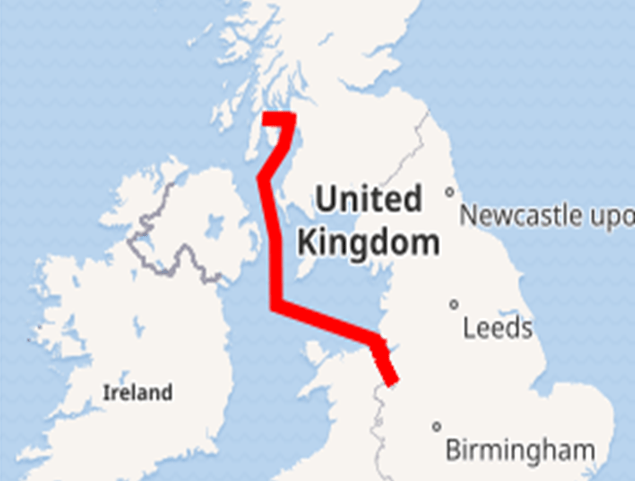
It has been reported that the line losses for the Western HVDC Link are less than 3 %. This can be divided into a 1.5% loss for the conversions and 1.5% for the line losses of the 385 km submarine line. Factoring in the Tasersiaq submarine line length of 745 km, the expected total losses will be 5%.
Total losses on the +-600kV overhead segment are expected to be a total of 7%.
HVDC Link Cost for 2,250 MW Project to Quebec City
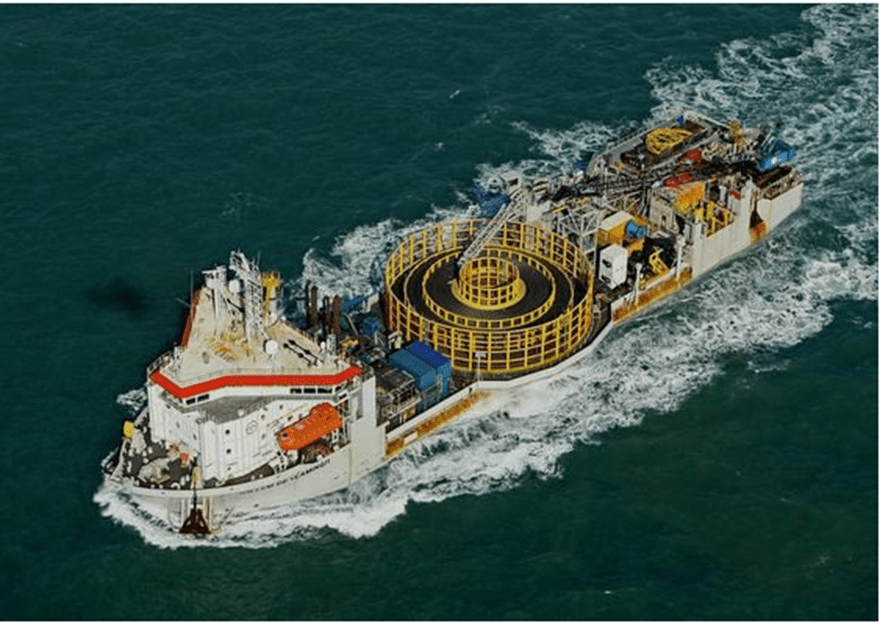
The undersea cable for the 386 km long Western HVDC Link cost 800 million euros and the remainder of the project including converters cost 300 million euros. [39] Factoring in eurozone inflation from 2012 to 2023 of 1.28, adjusting for the 745 km length, and converting from euros to $ at current rate of 1.07 $ per euro, gives an estimate of $2.53 billion for the undersea links.
The overhead transmission line segments are similar to the Belo Monte Bipole II link in Brazil. [38] This UHVDC overhead transmission link extends for 2539 km. The link for this project will use the same +-600 kV as the undersea link. For these overhead segments only the cost of the power lines and not the converters will be factored into the estimate. The converters estimated with the undersea segments also serve for the overhead segments. The reported price of the Belo Monte Bipole II link was $2.14 billion. Correcting for 2017-2023 inflation factor of 1.26, a line length of 2380 km, and subtracting an estimated converters cost of $0.41 billion gives an estimated cost for the overhead segments of $2.12 billion. So, the total expected transmission line cost to transmit 2,250 MW from Tasersiaq Lake to Quebec City Canada is $4.7 billion.
A transmission line operation and maintenance cost estimate presented in the 2021 Transmission Cost Report of the Australian Energy Market Operator estimates that operation and maintenance costs of a transmission project are 1% per year of total capital costs. [40] The 1% estimate gives an annual O&M cost of $47 million per year. Hakan Acaroglu et al [41] estimate that the combined operation and maintenance costs of the transmission line and converters is 0.4% per year of the capital cost for an undersea cable and 1.6% of the capital cost for an overhead transmission line. The second approach gives an estimate of $10 million for the submarine cable O&M and $34 million for the O&M of the overhead transmission line, for a total of $44 million per year. A third estimate by Zhi Qiang Zhao et al [42] gives a substation maintenance rate of 2.0% and a line maintenance rate of 1.5% for an overhead cable. This would give an average of 1.7% for the HVDC overhead line part of the link or $36 million for the overhead line yearly maintenance. Based on these three estimates a yearly O&M cost of $44 million will be estimated for the combined power transmission links.
Only a small portion of the total transmission line construction will take place in Greenland. The portion of the effort in Greenland is estimated at 5% of the total project cost. One HVDC converter station will be built at the powerhouse and an overhead HVDC power line will be run to the Greenland coast. Based upon this estimate and assuming that 50% of the cost is for labor, it is estimated that the power line workforce in Greenland will be approximately 350 persons during the 5-year construction period.
Levelized Cost of Electricity (LCOE)
The levelized cost of energy (LCOE) provides a yardstick that allows comparison of the relative costs of energy from different sources. It relies on the level of energy produced, total period of production, capital expenditures, cost of capital, and project maintenance costs. The National Renewable Energy Laboratory (NREL) offers a calculator for the computation of LCOE. [36] For this project the following inputs are used.
This estimate is prepared for the project that produces 2,250 MW of electricity. LCOE estimates are presented for the cost of electricity at the output of the power station and also for electricity delivered via HVDC power lines to Quebec City, Canada.
LCOE for 2,250 MW Project
| Inputs to NREL LCOE Calculator | At Power House with No Power Line Costs Included | Including Power Line Costs to Quebec City |
| Project Period (years) | 40 | 40 |
| Discount Rate (%) | 5 | 5 |
| Capital Cost ($/kW) | 1822 | 4400 |
| Capacity Factor (%) | .95 | .95 |
| Fixed O&M Cost ($/kW-yr) | 48 | 76 |
| Simple Levelized Cost of Renewable Energy ($/kWh) | .019 $/kWh | .040 $/kWh |
Convert Energy to Green Hydrogen
A great deal of attention and government funding is currently being expended on the development of green hydrogen technology and infrastructure. However, there are currently no large tankers that can carry liquified H2 or compressed H2 at 700 bar. The lack of technical maturity or commercial maturity in H2 technologies, coupled with inefficiencies and high costs in the chain of conversions from electricity to H2, shipment of H2, and combustion of H2 make the choice of green hydrogen an extremely high-risk proposition at this time. This may change, but the time horizon for maturity of the green hydrogen economy is too long to be seriously considered for this project.
Convert Energy to Green Ammonia
One significant tradeoff in the design of the Tasersiaq Lake project is between the use of a High Voltage Direct Current (HVDC) powerline to transfer electrical power to the US versus the conversion of the electrical power to green ammonia and the shipment of the ammonia by tanker to the US or Europe.
Ammonia is a commodity that is widely used in industrial processes and agriculture. The market is well established. Large transport vessels for the shipment of ammonia are widely available.
However, the costs of producing green ammonia and shipping it to the US or Europe make it currently non-competitive with ammonia produced using natural gas. An analysis in the Green Ammonia Cost section that follows shows that the cost of delivered green ammonia produced in this project would cost in the range of $351 to $391 per tonne. Refer to Appendix E for details.
Unfortunately, these green ammonia costs are substantially higher than costs reported for ammonia produced from natural gas. The cost of producing ammonia from natural gas at a natural gas price of $ 3.00 per MMBtu is approximately $220 per tonne without CO2 sequestration or $300 per tonne with CO2 sequestration. [43]
Since the Tasersiaq Hydro Concept that utilizes HVDC powerlines offers a very competitive Levelized Cost of Electricity (LCOE) and since the approach that uses electricity to ammonia conversion is not competitive, it is clear that the concept that delivers electricity to Quebec over HVDC powerlines offers a better opportunity for profitability.
Citations and Links
36. National Renewable Energy Laboratory, US Department of Energy, Levelized Cost of Energy Calculator Levelized Cost of Energy Calculator | Energy Analysis | NREL
37. Line Losses Western HVDC link UK – Siemens to increase power transmission capacity between England and Scotland (archive.org)
38. Belo Monte-Rio de Janeiro UHVDC Transmission Project Belo Monte-Rio de Janeiro UHVDC Transmission Project – NS Energy (nsenergybusiness.com)
39. Prysmian Group News release, Prysmain secures the highest value cable project ever awarded, 16 Feb 2012, en_2012-Highest-value-contract.html | Prysmian Group
40. 2021 Transmission Cost Report, Australian Energy Market Operator, August 2021 Para 2.4 transmission-cost-report.pdf (aemo.com.au)
41. Hakan Acaroglu, Fausto Pedro Garcia Marquez, A life-cycle cost analysis of High Voltage Direct Current utilization for solar energy systems: The case study in Turkey, Journal of Cleaner Production, Volume 360, 1 August 2022, 132128, Tables 3.2 and 3.5 A life-cycle cost analysis of High Voltage Direct Current utilization for solar energy systems: The case study in Turkey – ScienceDirect
42. Zhi Qiang Zhao et al, Research on the Economy of UHVDC Transmission under the Background of Global Energy Interconnect, IOP Conf. Ser.: Mater. Sci. Eng. 439 052022 2018 Microsoft Word – PY6040 (iop.org)
43. The Cost of CO2-free Ammonia, Ammonia Energy, Bunro Shiozawa, Nov 12, 2020 The Cost of CO2-free Ammonia – Ammonia Energy Association
 Tasersiaq Lake Greenland Hydroelectric Project Concept